
Skip to content
Guide

State annual report dates for your companies

It depends on the state and the type of entity: some states ask every LLC and corporation to file each year, some every two years, and some ask nothing of LLCs at all.

✓ Encrypted in transit and at rest✓ Two-factor sign-in✓ You choose who sees what✓ Never sold, never used to train AI✓ Export or delete any time✓ Type or upload today
What decides the date

The state where the entity was formed, and every state where it is registered to do business.

The entity type. Rules for corporations and LLCs often differ within the same state.

The anchor date: many states use the formation anniversary; others use one fixed date for everyone.

Missouri

Missouri is where we started. Requirements there differ between corporations and LLCs, so confirm each entity on the Missouri Secretary of State’s business services page rather than assuming one rule covers all of them.

Keeping it straight across several entities

  • One line per entity per state, with the due date and the state’s own page
  • A reminder well ahead of the date
  • A note of who files — you, your registered agent or your attorney
  • The confirmation kept with the company’s records

What an annual report is

Most states require an LLC or corporation to file a short report every year or two confirming its name, principal address, registered agent and, in many states, its managers or officers. Some states call it an annual report, others a statement of information, a periodic report or a franchise tax report. A fee is usually due with it.

It is separate from a tax return. A company with no income can still owe the report, and a company that misses it can lose good standing and eventually be administratively dissolved.

How the date is set

States use different rules. In some, the report is due on a fixed date for every company. In others it is due in the anniversary month of the company’s formation or registration. A few tie it to the end of the fiscal year. A company registered to do business in a second state usually owes a report there as well, on that state’s schedule.

Missouri is an example of how this can vary inside one state: corporations file a report with the Secretary of State on a schedule tied to the month of incorporation, while Missouri LLCs do not file an annual report at all. Always confirm the current rule with the Secretary of State where each company is formed and registered.

Keeping several companies straight

  • List each company with its state of formation and every state where it is registered.
  • Record the formation date and the state’s due-date rule beside it.
  • Record the registered agent and when its service renews.
  • Keep the confirmation of each filing with the company’s papers.

With three or four companies in two states, these dates are easy to lose track of, and notices sent to an old registered agent address are a common cause of a missed filing.

Who files

You, your attorney or a registered agent service files the report with the state. A record of the names, addresses and dates the form asks for makes that a few minutes’ work.

The view that does it

Demo account · synthetic data · desktop
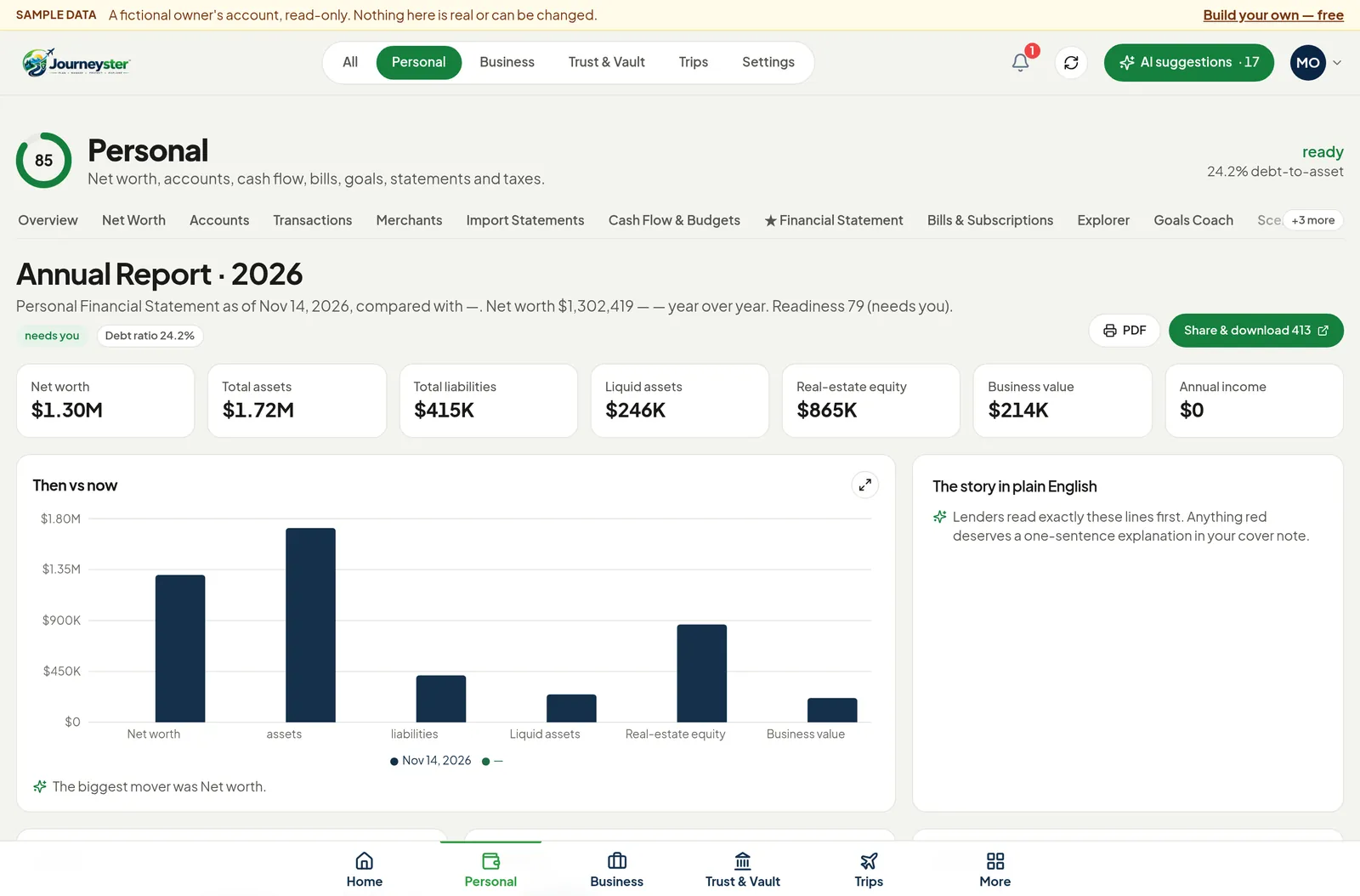
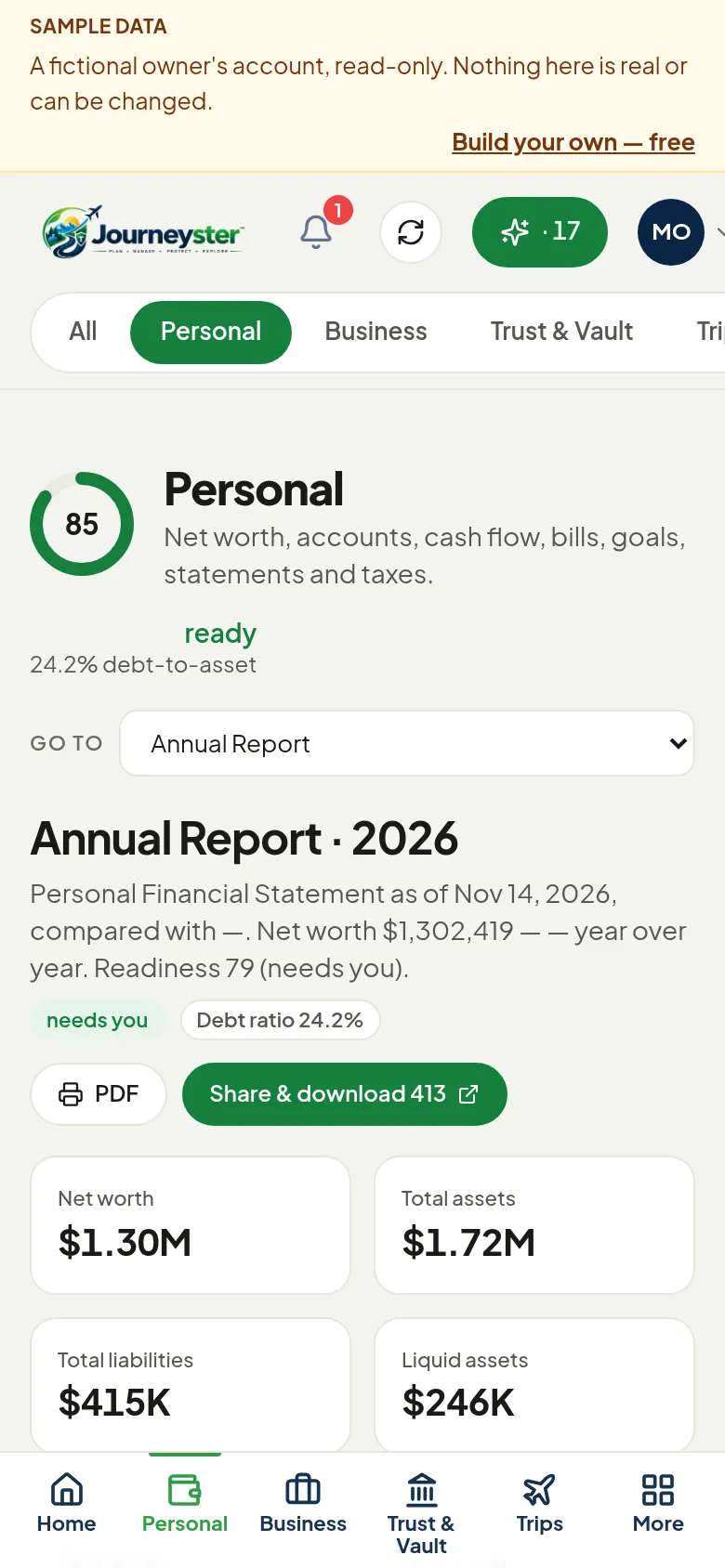
The annual report package for one company: the figures and names the state form asks for.

Where this lives in Journeyster

Readiness tracks an annual-report ask per company and prepares the package. You, your agent or your attorney file it; Journeyster does not file with any state. State coverage is being added state by state.

A general guide, not legal, tax or lending advice. Your lender, CPA or attorney decides what applies to you.

What this gets ready
Personal financial statementTax package per entityState annual report
Connects to
Start free →See a sample2 minutes · no card · type or upload your first statement